Movies

HomeMoviesSearchTV SeriesBookmarksView Source
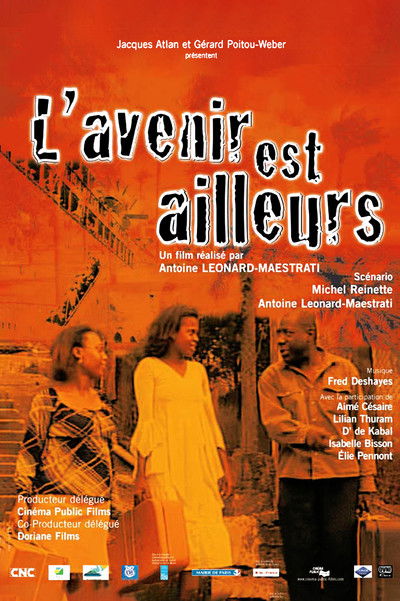
L'Avenir est ailleurs

L'Avenir est ailleurs

Genres

Documentary

OverView

Others

Budget

$--

Revenue

$--

Status

Released

Original Language

French

Runtime

0 mins

Rating

10/10

Release Date

28 March 2007

Country

France

Cast

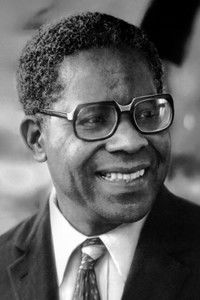
Aimé Césaire

Aimé Césaire

Self

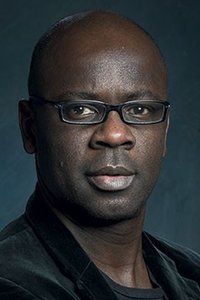
Lilian Thuram

Lilian Thuram

Self

Similar Movies

6.8

CHoosing at Twenty

August 2017 •French

Between 1954-1962, one hundred to three hundred young French people refused to participate in the Algerian war. These rebels, soldiers or conscripts were non-violent or anti-colonialists. Some took refuge in Switzerland where Swiss citizens came to their aid, while in France they were condemned as traitors to the country. In 1962, a few months after Independence, Villi Hermann went to a region devastated by war near the Algerian-Moroccan border, to help rebuild a school. In 2016 he returned to Algeria and reunited with his former students. He also met French refractories, now living in France or Switzerland.

9.0

The Words Women Spoke One Day

March 2024 •French

1962, at the end of the Algerian War, Algerian independence activists are released from Rennes prison. For one night, filmmaker Yann Le Masson films them. They tell him their vision for the future of Algeria and the place women must occupy in the new society to be built. Fifty years later, with the soundtrack missing, Raphaël Pillosio sets out to find these women. Two deaf people set about lip-reading the women filmed by Yann Le Masson, revealing snatches of sentences, words cut short by the camera's shifts. An investigative film in which the few activists still alive discover their old testimonies and tell us their silent story. The reconstruction of the lost soundtrack will remain in suspense; no happy ending will come to absorb the absence, to cancel the ferocious operation of time. An essay film about cinema that depicts their disappearance, and forever keeps them alive.

6.7

Money, Freedom, a Story of CFA Franc

November 2022 •French

The former French colonies in Central and West Africa have been independent since 1960, but most of these countries still use the currency of the former oppressor: the CFA franc. It was linked to the French franc when it was introduced, so the national bank in Paris controlled monetary policy. Now the currency has a fixed exchange rate with the euro. The link with the European currency strongly influences the monetary policy of CFA countries. And that means the value of the CFA franc is defined by political decisions taken elsewhere, rather than by the domestic economy.

10.0

La Bataille d'Alger, l'empreinte

January 2018 •French

Cheikh Djemaï looks back on the genesis of Gillo Pontecorvo’s feature film, The Battle of Algiers (1965). Through archive images, extracts from the film and interviews with personalities, the filmmaker retraces the journey of a major work - from the events of the Algiers Casbah (1956-1957) to the presentation of the Lion of 'Or causing the anger of the French delegation in Venice - which left its mark as much in the history of cinema as in that of Algeria.

7.0

Stonebreakers

November 2022 •English

In a year of uprisings and political unrest, Stonebreakers documents the fights around monuments in the United States and explores the shifting landscapes of the nation's historical memory.

10.0

Paroles d'un Prisonnier Français de l'ALN

November 2010 •French

The image of French prisoners was very often evoked in Algerian cinema and literature, but until today, no Algerian or even European report or documentary had given voice to one of these French prisoners of the war of Algeria. In the interest of truth and writing history, we set out in search of one of these French witnesses. This witness is René Rouby, prisoner of Amirouche's group for more than 114 days in 1958 in the Akfadou region in Kabylia. This is the first testimony from a French prisoner of the ALN (the National Liberation Army).

0.0

Notes of Resistance and Erasure

June 2021 •English

This experimental short traces the lifespan of the graffiti and murals present at the occupation of NYC’s City Hall in June and July of 2020. The encampment formed to demand the abolishment of the NYPD and the reallocation of its resources to housing, education, and other social programs.

0.0

Ferguson Rises

June 2021 •English

Before George Floyd, before Breonna Taylor, before America knew about Black Lives Matter, there was Michael Brown, Jr. On August 9th, 2014, in Ferguson, Missouri, a white police officer fatally shot an unarmed Brown. The community reacted in protest, anger, frustration, and fear. Six years later, a new story emerges - one filled with hope, love, and beauty.

7.6

The Zerda or the Songs of Forgetting

February 1983 •French

“La Zerda and the songs of oblivion” (1982) is one of only two films made by the Algerian novelist Assia Djebar, with “La Nouba des femmes du mont Chenoua” (1977). Powerful poetic essay based on archives, in which Assia Djebar – in collaboration with the poet Malek Alloula and the composer Ahmed Essyad – deconstructs the French colonial propaganda of the Pathé-Gaumont newsreels from 1912 to 1942, to reveal the signs of revolt among the subjugated North African population. Through the reassembly of these propaganda images, Djebar recovers the history of the Zerda ceremonies, suggesting that the power and mysticism of this tradition were obliterated and erased by the predatory voyeurism of the colonial gaze. This very gaze is thus subverted and a hidden tradition of resistance and struggle is revealed, against any exoticizing and orientalist temptation.

0.0

Strange Days Diary NYC

October 2024 •English

One neighborhood in New York City, March 2020: the coronavirus is spreading rapidly, the federal government is clueless, and life seems increasingly surreal. A month later, the city has become an epicenter of the pandemic as the death rate spirals upwards. Then the racial justice protests erupt... Strange Days Diary NYC is an intimate account of living through a disruptive, frightening, yet inspiring time.

7.6

You Think the Earth Is a Dead Thing

October 2019 •French

Just one of the many far-reaching impacts of the slave trade on human history is on agriculture and horticulture. While the French plantation owners on the Caribbean island of Martinique had their gardens laid out, Versailles-style, their enslaved workers continued their tradition of using medicinal wild herbs. Nowadays these herbs represent one of several resources through which the people of Martinique counter the health and ecological ravage caused by the use of pesticides on the banana plantations. Farmers are reclaiming uncultivated lands to grow indigenous vegetables, without any industrial pesticides; they fight boldly for simple biodiversity.

10.0

How the Monuments Came Down

June 2021 •English

How the Monuments Came Down is a timely and searing look at the history of white supremacy and Black resistance in Richmond. The feature-length film-brought to life by history-makers, descendants, scholars, and activists-reveals how monuments to Confederate leaders stood for more than a century, and why they fell.

8.0

Two Lives for Algeria and All the Wretched of the Earth

January 2025 •French

In 1994, at over seventy years old, Gilberte and William Sportisse, threatened by the FIS, arrived from Algeria. Of Jewish faith, he of Arabic mother tongue, they formed a fighting couple, started for the independence of Algeria, always with an unshakeable faith in humanity. They enjoy recounting the participation of Algerian Jews in the Second World War and the struggle for Algerian independence. They provide us with previously unpublished information on the public and clandestine struggles of the Algerian Communist Party before and after independence, and on the repression of activists who, like William and Gilberte Sportisse, were tortured and imprisoned after Colonel Boumédiène came to power. The film is an ode to understanding between people of different origins or cultures and a tribute to a couple whose youthful character and enthusiasm still astonish.

10.0

Pierre Clément, Cinéma et Révolution

October 2023 •Arabic

Pierre Clément, student and photographer of René Vauthier, first accompanied him to Tunisia to make a film on the country's independence in 1957. Destiny led him to Algeria and his presence in February 1958 at the Tunisian-Algerian border changed his life. . Forever. He took his camera and photographed the attacks on Sakia Sidi Youssef before committing himself body and soul to the Algerian cause. Shortly after, he directed the film “Algerian Refugees” before being arrested, tortured and imprisoned, while his third film, “The National Liberation Army in Almaki”, was not finished. Abdel Nour Zahzah, a director who commemorates Pierre Clément, the director who risked his life, the brother of the Algerian resistance, who disappeared in 2007.

10.0

Guns of Freedom

January 1961 •Arabic

This docu-fiction recounts the difficulties overcome by an ALN ​​detachment whose perilous mission is to transport weapons and ammunition from Tunisia across the Algerian Sahara during the Algerian liberation war (1954-1962) against the French army of occupation.

10.0

Abd El-Kader

January 2014 •French

Illustrated with archival photographs, animations and live action, this film explores the history and historical and spiritual heritage of Emir Abd El-Kader. Algerian leader of the 19th century, was admired by Abraham Lincoln and celebrated to this day by the Red Cross as a great humanitarian. Emir Abd el-Kader, the man who challenged the French armies from 1832 to 1847 before creating the bases of a real Algerian state, is today considered by independent Algeria as one of the most outstanding figures. of its history. The nobility of his attitude after his capture and the very effective protection he brought to the Christians of Damascus at the end of his life also earned him great prestige among his former adversaries. A documentary told in dialectal Arabic by the voice of Amazigh Kateb.

10.0

Gerboise Bleue

February 2009 •French

"Gerboise bleue", the first French atomic test carried out on February 13, 1960 in the Algerian Sahara, is the starting point of France's nuclear power. These are powerful radioactive aerial shots carried out in areas belonging to the French army. Underground tests will follow, even after the independence of Algeria. From 1960 to 1978, 30,000 people were exposed in the Sahara. The French army was recognized recognized nine irradiations. No complaint against the army or the Atomic Energy Commission has resulted. Three requests for a commission of inquiry were rejected by the National Defense Commission. For the first time, the last survivors bear witness to their fight for the recognition of their illnesses, and revealed to themselves in what conditions the shootings took place. The director goes to the zero point of "Gerboise Bleue", forbidden access for 47 years by the Algerian authorities

10.0

Aimé Césaire, un Nègre fondamental

November 2007 •French

10.0

Sawt Echaâb

January 1961 •Arabic

“La Voix du Peuple,” composed of archival photographs by René Vauthier and others, exposes the root causes of the armed conflict of the Algerian resistance. Participating in a war of real images against French colonial propaganda, these images aimed to show the images that the occupier had censored or distorted, by showing the extortions of the French occupation army: torture, arrests and arbitrary executions, napalm bombings, roundabout fires, erasing entire villages from the map, etc. This is what the French media described as a “pacification campaign”.

9.0

Algeria, Special Weapons Sections

March 2025 •French

This documentary by director Claire Billet and historian Christophe Lafaye details the massive and systematic use of chemical weapons during the Algerian War. Algerian fighters and civilians, sheltering in caves, were gassed by "special weapons sections" of the French army. The gas identified on military documents is CN2D, whose widespread use forced insurgents to flee "treated" sites, at the risk of dying there. The method is reminiscent of the "enfumades" used by the French expeditionary force during the conquest of Algeria in the 19th century. Between 8,000 and 10,000 such operations are believed to have taken place on Algerian soil between 1956 and 1962. This historical aspect is little known due to the difficulty of accessing archives, many of which are still classified, raising questions about memory, historical truth, and justice.