Movies

HomeMoviesSearchTV SeriesBookmarksView Source
Hôtel Terminus: The Life and Times of Klaus Barbie

Hôtel Terminus: The Life and Times of Klaus Barbie

Genres

WarDocumentary

OverView

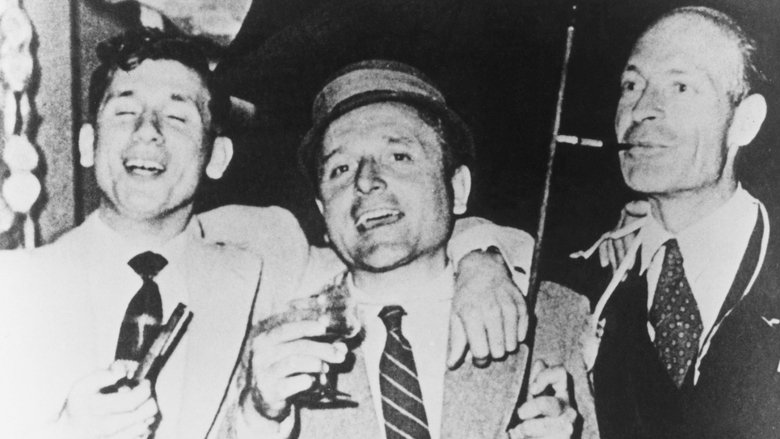
Marcel Ophuls' riveting film details the heinous legacy of the Gestapo head dubbed "The Butcher of Lyon." Responsible for over 4,000 deaths in occupied France during World War II, Barbie would escape—with U.S. help—to South America in 1951, where he lived until a global manhunt led to his 1983 arrest and subsequent trial.

Others

Budget

$--

Revenue

$341000

Status

Released

Original Language

English

Runtime

268 mins

Rating

7/10

Release Date

01 November 1988

Country

Germany

Cast

Klaus Barbie

Klaus Barbie

Self

Marcel Ophüls

Marcel Ophüls

Self

Serge Klarsfeld

Serge Klarsfeld

Self

Beate Klarsfeld

Beate Klarsfeld

Self

Claude Lanzmann

Claude Lanzmann

Self

Daniel Cohn-Bendit

Daniel Cohn-Bendit

Self

Günter Grass

Günter Grass

Self

Jacques Vergès

Jacques Vergès

Self

Régis Debray

Régis Debray

Self

Bertrand Tavernier

Bertrand Tavernier

Self

Raymond Aubrac

Raymond Aubrac

Self

Lucie Aubrac

Lucie Aubrac

Self

Similar Movies

6.6

The Aryans

April 2014 •German

THE ARYANS is Mo Asumang's personal journey into the madness of racism during which she meets German neo-Nazis, the US leading racist, the notorious Tom Metzger and Ku Klux Klan members in the alarming twilight of the Midwest. In The ARYANS Mo questions the completely wrong interpretation of "Aryanism" - a phenomenon of the tall, blond and blue-eyed master race.

8.4

The Pianist

September 2002 •English

The true story of pianist Władysław Szpilman's experiences in Warsaw during the Nazi occupation. When the Jews of the city find themselves forced into a ghetto, Szpilman finds work playing in a café; and when his family is deported in 1942, he stays behind, works for a while as a laborer, and eventually goes into hiding in the ruins of the war-torn city.

8.6

Schindler's List

December 1993 •English

The true story of how businessman Oskar Schindler saved over a thousand Jewish lives from the Nazis while they worked as slaves in his factory during World War II.

7.9

Downfall

September 2004 •German

In April of 1945, Germany stands at the brink of defeat with the Russian Army closing in from the east and the Allied Expeditionary Force attacking from the west. In Berlin, capital of the Third Reich, Adolf Hitler proclaims that Germany will still achieve victory and orders his generals and advisers to fight to the last man. When the end finally does come, and Hitler lies dead by his own hand, what is left of his military must find a way to end the killing that is the Battle of Berlin, and lay down their arms in surrender.

6.8

The World Will Tremble

March 2025 •English

The incredible, untold true story of how a group of prisoners attempt a seemingly impossible escape from the first Nazi death camp in order to provide the first eyewitness account of the Holocaust.

8.0

Rome, Open City

October 1945 •Italian

In WWII-era Rome, underground resistance leader Manfredi attempts to evade the Gestapo by enlisting the help of Pina, the fiancée of a fellow member of the resistance, and Don Pietro, the priest due to oversee her marriage. But it’s not long before the Nazis and the local police find him.

5.8

The Good German

December 2006 •English

An American journalist arrives in Berlin just after the end of World War Two. He becomes involved in a murder mystery surrounding a dead GI who washes up at a lakeside mansion during the Potsdam negotiations between the Allied powers. Soon his investigation connects with his search for his married pre-war German lover.

7.8

To Be or Not to Be

March 1942 •English

During the Nazi occupation of Poland, an acting troupe becomes embroiled in a Polish soldier's efforts to track down a German spy.

0.0

Łódź Ghetto

March 1989 •English

The Polish city of Łódź was under Nazi occupation for nearly the entirety of WWII. The segregation of the Jewish population into the ghetto, and the subsequent horrors are vividly chronicled via newsreels and photographs. The narration is taken almost entirely from journals and diaries of those who lived–and died–through the course of the occupation, with the number of different narrators diminishing as the film progresses, symbolic of the death of each narrator.

7.5

Au Revoir les Enfants

October 1987 •French

Au revoir les enfants tells a heartbreaking story of friendship and devastating loss concerning two boys living in Nazi-occupied France. At a provincial Catholic boarding school, the precocious youths enjoy true camaraderie—until a secret is revealed. Based on events from writer-director Malle’s own childhood, the film is a subtle, precisely observed tale of courage, cowardice, and tragic awakening.

4.2

Third Time

April 1963 •Russian

The film is based on the real fact — football «The Death Match» between the German team and a team of Soviet prisoners of war, former "Dinamo". It happened in Kiev on June 22, 1942. Anticipating the possibility of losing, the Germans made a condition — defeat or death. If the Germans won, the Soviet footballers were promised freedom...

0.0

America and the Holocaust: Deceit and Indifference

April 1994 •English

As the campaign to force Jews out of Germany ramps up, the American government blocks efforts to help rescue many of these displaced persons, and Americans' antisemitism only seems to get worse.

7.9

The Great Escape

July 1963 •English

The Nazis, exasperated at the number of escapes from their prison camps by a relatively small number of Allied prisoners, relocate them to a high-security 'escape-proof' camp to sit out the remainder of the war. Undaunted, the prisoners plan one of the most ambitious escape attempts of World War II. Based on a true story.

7.3

The Smuggler and Her Charges

November 2016 •French

A captivating and personal detective story that uncovers the truth behind the childhood of Michaël Prazan's father, who escaped from Nazi-occupied France in 1942 thanks to the efforts of a female smuggler with mysterious motivations.

5.0

Francisco Boix: A Photographer in Hell

January 2000 •Spanish

In 1939, just finished the Spanish Civil War, Spanish republican photographer Francesc Boix escapes from Spain; but is captured by the Nazis in 1940 and imprisoned in the Mauthausen concentration camp, in Austria, a year later. There, he works as a prisoner in the SS Photographic Service, hiding, between 1943 and 1945, around 20,000 negatives that later will be presented as evidence during several trials conducted against Nazi war criminals after World War II.

6.9

The Tin Drum

May 1979 •German

In 1924, Oskar Matzerath is born in the Free City of Danzig. At age three, he falls down a flight of stairs and stops growing. In 1939, World War II breaks out.

6.8

Olympia Part One: Festival of the Nations

April 1938 •German

Starting with a long and lyrical overture, evoking the origins of the Olympic Games in ancient Greece, Riefenstahl covers twenty-one athletic events in the first half of this two-part love letter to the human body and spirit, culminating with the marathon, where Jesse Owens became the first track and field athlete to win four gold medals in a single Olympics.

6.7

Olympia Part Two: Festival of Beauty

June 1938 •German

Part two of Leni Riefenstahl's monumental examination of the 1938 Olympic Games, the cameras leave the main stadium and venture into the many halls and fields deployed for such sports as fencing, polo, cycling, and the modern pentathlon, which was won by American Glenn Morris.

8.3

The Great Dictator

October 1940 •English

Dictator Adenoid Hynkel tries to expand his empire while a poor Jewish barber tries to avoid persecution from Hynkel's regime.

6.7

The Assault

February 1986 •Dutch

At the end of WWII the Dutch resistance kills a German officer in front of the house of a Dutch family. Years after the war the young boy who witnessed the killing runs into the members of the resistance who committed the killing.