Movies

HomeMoviesSearchTV SeriesBookmarksView Source
The End of Memory

The End of Memory

Genres

Documentary

OverView

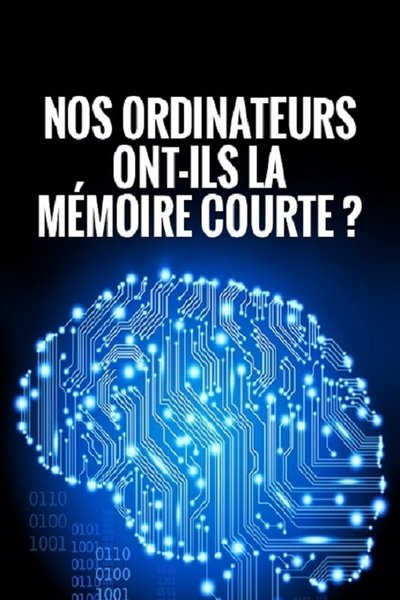
Each day, some 2.5 trillion bytes of data are exchanged, a deluge known as "big data." How can we classify, store, and give meaning to this mass of digital information? Will our digital society remain capable of producing a lasting memory? Learn the fate of memory storage in the future.

Others

Budget

$--

Revenue

$--

Status

Released

Original Language

French

Runtime

54 mins

Rating

7/10

Release Date

11 December 2015

Country

Cast

Similar Movies

9.0

The A350: Star of the Skies

January 2015 •English

After 10 years of tests and 12 billion Euros invested, the state-of-the-art Airbus jet completed its first commercial flight in January 2015. We will discover how it was conceived and built, and explore its technological innovations every step of the way.

0.0

The Real Beauty and the Beast

June 2013 •English

It's a condition known as "hypertrichosis" or "Ambras Syndrome," but in the 1500s it would transform one man into a national sensation and iconic fairy-tale character. His name: Petrus Gonsalvus, more commonly known today as the hairy hero of Beauty and the Beast.

8.0

In the belly of AI

February 2025 •French

Magical, autonomous, all-powerful… Artificial intelligences feed our dreams as well as our nightmares. But while tech giants promise the advent of a new humanity, the reality of their production remains totally hidden. While data centers are concreting landscapes and drying up rivers, millions of workers around the world are preparing the billions of data that will feed the voracious algorithms of Big Tech, at the cost of their mental and emotional health. They are hidden in the belly of AI. Could they be the collateral damage of the ideology of “Longtermism” that has been brewing in Silicon Valley for several years?

7.9

What Killed the Roman Empire?

November 2022 •French

Why did the Roman Empire, which dominated Europe and the Mediterranean for five centuries, inexorably weaken until it disappeared? Archaeologists, specialists in ancient pathologies and climate historians are now accumulating clues converging on the same factors: a powerful cooling and pandemics. A disease, whose symptoms described by the Greek physician Galen are reminiscent of those of smallpox, struck Rome in 167, soon devastating its army. At the same time, a sudden climatic disorder that was underway as far as Eurasia caused agricultural yields to plummet and led to the westward migration of the Huns. Plagued by economic and military difficulties, attacked from all sides by barbarian tribes, the Roman edifice gradually cracked.

9.0

Nature : pour une réconciliation

February 2025 •French

Combining poetry, science and emotion, this film traces the history of life, from its cosmic origins to its evolution on our planet, through the wonders of biodiversity and the contemporary challenges it faces. Through spectacular images, Yann Arthus-Bertrand questions the paradoxes of our times and urges a collective transformation to reconcile humanity with nature.

7.2

The Journey of Man: A Genetic Odyssey

January 2003 •English

Many geneticists and archaeologists have long surmised that human life began in Africa. Dr. Spencer Wells, one of a group of scientists studying the origin of human life, offers evidence and theories to support such a thesis in this PBS special. He claims that Africa was populated by only a few thousand people that some deserted their homeland in a conquest that has resulted in global domination.

6.9

Nothing to Hide

September 2017 •English

NOTHING TO HIDE is an independent documentary dealing with surveillance and its acceptance by the general public through the "I have nothing to hide" argument. The documentary was produced and directed by a pair of Berlin-based journalists, Mihaela Gladovic and Marc Meillassoux. It was crowdfunded by over 400 backers. NOTHING TO HIDE questions the growing, puzzling and passive public acceptance of massive corporate and governmental incursions into individual and group privacy and rights. After the emotion initially triggered by the Snowden revelations, it seems that the general public has finally accepted to live in a monitored digital world.

8.0

Victorian Britain on Film

November 2021 •English

Offers audiences a unique window into a bygone era when a thrilling new invention, the motion picture camera, first captures a nation on film.

7.5

The Genius of George Boole

September 2015 •English

Narrated by Oscar-winning actor Jeremy Irons, The Genius of George Boole assembles academics and industry leaders from across the globe to explore the life and importance of one of the world’s greatest unsung heroes.

5.7

In the Frozen Tomb of Mongolia

August 2014 •French

7.0

Searching for Skylab, America's Forgotten Triumph

February 2019 •English

The first American space station Skylab is found in pieces scattered in Western Australia. Putting these pieces back together and re-tracing the Skylab program back to its very conception reveals the cornerstone of human space exploration.

9.0

What Darwin Never Knew

December 2009 •English

Earth teems with a staggering variety of animals, including 9,000 kinds of birds, 28,000 types of fish, and more than 350,000 species of beetles. What explains this explosion of living creatures—1.4 million different species discovered so far, with perhaps another 50 million to go? The source of life's endless forms was a profound mystery until Charles Darwin brought forth his revolutionary idea of natural selection. But Darwin's radical insights raised as many questions as they answered. What actually drives evolution and turns one species into another? To what degree do different animals rely on the same genetic toolkit? And how did we evolve?

10.0

Voyage Inside the Cell

January 1999 •English

This narrated computer animation, with an original musical score, illuminates cellular mitosis. DNA self-replicates; chromosomes divide into two daughter cells; but it begins with a hormone entering the nucleus of a cell.

8.3

Your Inner Fish

April 2014 •English

How did your body become the complicated, quirky, amazing machine it is today? Anatomist Neil Shubin uncovers the answers in this 3-part science series that looks at human evolution. Using fossils, embryos and genes, he reveals how our bodies are the legacy of ancient fish, reptiles and primates — the ancestors you never knew were in your family tree.

7.3

Les Derniers Secrets de l'humanité

August 2023 •French

This series incorporates the latest animated 3D films to explore recent discoveries about human history, especially in Asia.

8.7

Préhistoire en Asie : L'Aventure humaine

April 2024 •French

9.0

Prehistoric Worlds

January 2020 •English

Five times, Earth has faced apocalyptic events that swept nearly all life from the face of the planet. What did these prehistoric creatures look like? What catastrophes caused their disappearance? And how did our distant ancestors survive and give rise to the world we know today?

6.4

Unlocking the Mystery of Life

May 2003 •English

Unlocking the Mystery of Life represents a unique programming opportunity for local stations. Its broadcast release coincides with the 50th anniversary of one of the greatest scientific breakthroughs in history-James Watson and Francis Crick's discovery that the DNA molecule carries hereditary information in the form of a code that many scientists have likened to computer software or a written language. This discovery (announced on April 25,1953) sparked a scientific revolution. But it also left a fundamental question unanswered. Where did the information in DNA come from? How did the software in the cell arise? Unlocking the Mystery of Life explores these questions through the stories of a growing number of scientists who no longer believe that natural selection or chemistry, alone, can explain life's origin. Instead, they think that the microscopic world of the cell provides evidence of purpose and design in nature.

0.0

Rosalind Franklin: DNA's Dark Lady

April 2003 •English

A documentary about Rosalind Franklin, the scientist who first photographed and discovered the shape of DNA.

7.7

Autopsie d'une intelligence artificielle

October 2022 •French