Movies

HomeMoviesSearchTV SeriesBookmarksView Source
Karakoram
Karakoram

Karakoram

Genres

DocumentaryAdventure

OverView

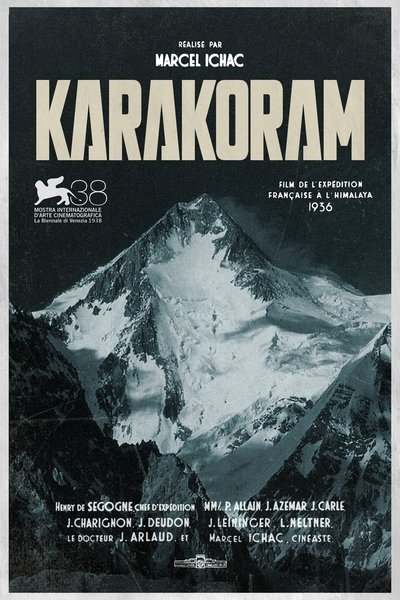
Account of the first French expedition to the Himalayas, which attempted to climb the hidden peak (Gasherbrum I) in 1936, from the preparations for the trip to the end of the ascent. After a long approach walk through quasi-desert regions, then on a huge glacier, the caravan of 700 porters arrives at the foot of Hidden Peak. The expedition was led by Henry de Ségogne, with Jean Charignon, Pierre Allain, Raymond Leininger, Jean Carle, Jean Deudon, Louis Neltner, Jacques Azémar, doctor Jeand Arlaud and director Marcel Ichac. Weather conditions, logistical problems and a strike among Sherpas forced the team to retire at 6900m on the south face. The film received the Silver Lion at the Venice Film Festival in 1938.

Others

Budget

$--

Revenue

$--

Status

Released

Original Language

French

Runtime

38 mins

Rating

0/10

Release Date

24 June 1937

Country

France
Cast

Pierre Allain

Pierre Allain

Self

Henry de Ségogne

Henry de Ségogne

Self

Marcel Ichac

Marcel Ichac

Self

Jean Charignon

Jean Charignon

Self

Raymond Leininger

Raymond Leininger

Self

Jean Carle

Jean Carle

Self

Jacques Azémar

Jacques Azémar

Self

Jean Arlaud

Jean Arlaud

Self

Louis Neltner

Louis Neltner

Self

Jean Deudon

Jean Deudon

Self

Marcel Laporte

Marcel Laporte

Narrator

Similar Movies

10.0

Alain Robert en solo integral

January 1991 •French

Before tackling the ascent of urban buildings, Alain Robert was considered one of the best specialists in the "climbing" of cliffs. His passion nearly cost him his life in 1982, when a fall rendered him 66% disabled. At the time the doctors were convinced that he could no longer indulge in this passion. This does not prevent him, by dint of motivation and training, from climbing more than 170 buildings around the world to date, and from soloing technical routes at his maximum level, such as "La Nuit du Lézard". (8a+) in Buoux (France), where here is "L'Ange en Décomposition", in 1991, a mythical course in the Gorges du Verdon.

10.0

Pyreneism Yesterday And Today

January 2019 •French

The word Pyreneism was invented by the writer Henri Beraldi at the end of the 19th century. Its definition did not come down to a simple practice of mountaineering in the Pyrenees. To be recognized as a Pyrenean, it was necessary to “ascend, write and feel”. An approach to the mountains, according to him, necessarily accompanied by an artistic or intellectual activity. This documentary looks back at the Pyrenees who have left their mark on history, before interviewing contemporary mountain dwellers who, through their mountain practice, consider themselves, or not, Pyreneanists. What prompted Beraldi to coin this term? Does it result from a Pyrenean complex facing the Alps? Chauvinism or a demand for identity? And today, does this word still have meaning? Beyond the reflection on the subject, this film is a wonderful tribute to the massif.

7.0

Farther Than the Eye Can See

January 2003 •English

Blind climber Erik Weihenmayer and his team's highly successful ascent of Mount Everest along with four other remarkable milestones on the mountain. Time magazine called this the most successful Everest expedition of all time.

10.0

The Cutting Edge

January 1980 •English

Yûichirô Miura, the man who skied down Everest, journeys to an 8,000 foot mountain in the midst of a frozen antarctic wasteland to experience the incomparable thrill of skiing where no one has skied before.

9.3

Best Of E.O.F.T. No. 8

January 2012 •German

The best films of the European Outdoor Film Tour 11/12.

10.0

The Ravier Brothers - The Pyrenees Adventure

November 2008 •French

The two brothers Jean and Pierre Ravier have opened almost all the "classic" (difficult) routes in climbing and mountaineering in the Pyrenees. Roped together at the waist using a few flat knots and little equipment, the two twin brothers achieved more than 200 firsts across the entire massif. A unique style and commitment, a state of mind made up of adventure, literature, inventiveness and friendship. Unclassifiable and outgoing, after 60 years of Pyrenees, their desire for the mountains is intact. When does a race start? How does the idea, the desire, come about? What sense does it make to only achieve firsts? And what is the role of the Pyrenees themselves in this reciprocal and endless game of attraction?

10.0

Entre Ciel et Neige

January 1960 •French

René Collet, skier member of the French team, guides a friend from the summit of the Aiguille du Midi. This descent is an opportunity to focus on the remarkable elements of the terrain: the cable car and its work still in progress, the surrounding peaks (Capucin, Mont Maudit, Mont Blanc). The two skiers stop regularly, here to observe climbers scaling the south face of the Aiguille, there to visit the Cosmiques Laboratory. They even take the time to rescue a skier stuck in a crevasse at the Séracs du Géant, before continuing their descent in style onto the Mer de Glace.

10.0

Jòlha Ròc, following in the footsteps of the Ravier brothers

November 2020 •French

Bastien Lardat and Jordi Noguere, two rope brothers, invite us to pay tribute to the pioneers of modern Pyrenees, through a new kind of sporting journey. Pierre and Jean Ravier opened the way several decades ago, drawing on the Pyrenean reliefs one of the most beautiful pages of amateur climbing excellence. In three days, climbing and connecting 3 legendary north faces by Ravier on foot is the crazy challenge that Bastien and Jordi have set themselves. 3 days, 3 routes, 85 km of pedestrian connection, to arrive at the end of the north face of the Tour de Marboré in Gavarnie, the Dièdre Jaune du Vignemale and the Embarradère du Pic du Midi d'Ossau.

10.0

Profession grimpeur, Eric Escoffier

January 1985 •French

A documentary portrait of the legend Eric Escoffier at the height of his mountaineering career. A true athlete, Escoffier has comprehensive, cutting-edge preparation in three different climbing disciplines: rock climbing, ice climbing and solo free climbing, without any safety devices. Philippe Lallet's camera follows Eric in his performances and in his preparation for one of the first La Sportroccia climbing competitions, in 1985 in Bardonecchia in Italy.

10.0

Generation Dry

January 2016 •French

It is a fact that our winters are less and less cold. Therefore it is harder and harder to get the conditions for ice-climbing. Fortunately, man adapts to his environment and makes progress: this is how dry-tooling was born. This movie will make you discover this discipline: its history, its evolution and the current practice. You will also see how much excitement dry tooling can bring. Dry-tooling now allows to free-climb some routes which were impossible to climb without aid in the past.

0.0

Vynes na horu svoj hrob

January 1979 •Slovak

The Himalayan mountain Makalu, located in Nepal, is the fifth highest mountain in the world. In 1973, a Czechoslovak expedition also attempted to climb it via the challenging route, the so-called South Pillar, but it ended tragically. The group of climbers led by the experienced Ivan Kaščák (real-life Ivan Gálfy) is composed of the fittest men. In the base camp and during the preparation of the advanced camps, the expedition struggles with common health problems - a sore tooth, intestinal problems or a cold. For the actual climb to the summit of Makalu, Kaščák chooses a young engineering student Milan, a colleague Karol who is a generation older than him, and a young man Jož. In the advanced camp, without Kaščák's knowledge, he gives up his place to the ambitious Karol. However, due to fatigue and lack of oxygen, Milan falls down a snowy slope and injures his head and spine. He can‘t be transported down.

8.0

Superhombre

July 2019 •Romanian

Horia Colibasanu is a dentist, father of two boys and elite climber. In 2008, he refused to abandon, at 7400 meters on the Annapurna, his sick companion, the Basque mountaineer Iñaki Ochoa de Olza, implanted his own life in danger. His action dazzled the climbing community. Despite this tragic incident, he continued to climb in pure alpine style, without supplemental oxygen. In 2017, the 40-year-old Romanian athlete will return to Everest, after two unsuccessful attempts. For the first time, Horia is attempting a solo ascent.

10.0

La République nous appelle

January 1954 •French

The story of the ascent of the Aiguille de la République by mountaineers Jacques Fromentin and Michel Bastien. The Aiguille de la République, in the Mont-Blanc massif, culminates at an altitude of 3,305 meters among the Aiguilles de Chamonix group of summits. In the Fontainebleau forest, children learn mountaineering techniques on the bouldering climbing site. In 1954, rock climbing was also practiced in the Chamonix valley. The Montenvers train crosses the viaduct taking tourists or athletes to the Mer de Glace viewpoint. The two climbers take an approach step and reach the Envers des Aiguilles refuge. They then climb this steep and smooth wall, progressing along the ridge. On the platform, a rope throw allows them to climb up and sit at the top to dominate the panorama. Then the return: abseiling from the summit block.

10.0

Jannu, Chronicle of a Conquest

January 1962 •French

Three years after the 1959 expedition, abandoned 350m from the summit, Lionel Terray leads a new assault on Jannu, one of the most demanding peaks in the Himalayas. At the base camp, equipment and food rations are prepared. The conditions are optimal and the ascent can begin. The camera follows the progress of the mountaineers and Sherpas as closely as possible, from one high-altitude camp to another: installing fixed ropes, progressing over crevasses, in the middle of frozen towers, vertically down immense ice falls or along the edge of sharp ridges. From 7000m, oxygen bottles become essential, as the difficulty of the climb prevents acclimatization. The expedition is a total success: the majority of its members reach the 7710m summit.

10.0

2T on Paiju Peak

December 2015 •Spanish

In 2013, Alberto Iñurrategi, Juan Vallejo and Mikel Zabalza desist in their attempt to climb Paiju Peak (6,610m). A year later, his steps cross with Mikel Renteria and Mentxu Mendieta from the WOP Foundation, who decide that the second attempt at Paiju Peak will be the first stage of their WOPeak project. The three members of the cordada land again in Pakistan. Identical scenery, the same objective and a maximum motivation for a challenge beyond mountaineering in a route full of emotions that ends with the opening of a new road in the heart of the Karakorum that they christened '2t'.

10.0

Cervin 1865, une première tragique

March 2015 •German

The first ascent of the Matterhorn was made on July 14, 1865 by Edward Whymper, Francis Douglas, Charles Hudson, Douglas Hadow, Michel Croz and two guides from Zermatt, Peter Taugwalder father and son. Douglas, Hudson, Hadow and Croz are killed on the descent after Hadow slips and drags the other three men down the north face. Whymper and the two Taugwalders, who survive, are later accused of having cut the rope that connected them to the rest of the group so as not to be dragged into the fall, but the ensuing investigation finds no evidence of their guilt and they are acquitted. The Matterhorn is the last great peak in the Alps to be conquered and its ascent marks the end of the golden age of mountaineering. One hundred and fifty years later, a team undertakes the same expedition in order to unravel the mystery.

6.6

Stars at Noon

January 1959 •French

Les Etoiles de Midi is an engaging docudrama about some of the more spectacular exploits of French mountain climbers over the last several decades. In one re-enacted story, there is a wartime escape through the mountains, and in another, a daring rescue of a pair of climbers who had been missing. The actors themselves are adept at the sport of climbing, and they give the scenes an immediacy and real daring that brings the stories alive. A combination of their acrobatics and skill and the outstanding episodes in the history of French climbing creates a winning 78 minutes.

8.0

The Himalayas

March 2011 •English

The highest mountain range in the world, the Himalayan range is far reaching, spanning thousands of miles, and holds within it an exceptionally diverse ecology. Coniferous and subtropical forests, wetlands, and montane grasslands are as much a part of this world as the inhospitable, frozen mountaintops that tower above. The word Himalaya is Sanskrit for abode of snow, fitting for a stretch of land that houses the world’s largest non polar ice masses. Extensive glacial networks feed Asia's major rivers including the Ganges, Indus, and Brahmaputra. More than a billion people rely on these glacier-fed water sources for drinking water and agriculture. The Himalayas are not only a remarkable expanse of natural beauty. They're also crucial for our survival.

7.2

Seven Years in Tibet

September 1997 •English

Austrian mountaineer Heinrich Harrer journeys to the Himalayas without his family to head an expedition in 1939. But when World War II breaks out, the arrogant Harrer falls into Allied forces' hands as a prisoner of war. He escapes with a fellow detainee and makes his way to Lhasa, Tibet, where he meets the 14-year-old Dalai Lama, whose friendship ultimately transforms his outlook on life.

0.0

Dans les pas du Groupe

October 2019 •French