Movies

HomeMoviesSearchTV SeriesBookmarksView Source
Celuloide colectivo: el cine en guerra

Celuloide colectivo: el cine en guerra

Genres

DocumentaryHistory

OverView

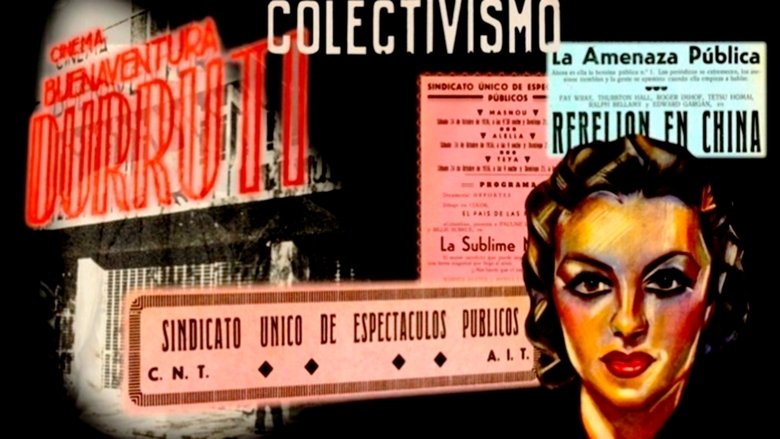
July, 1936. The terrible Spanish Civil War begins. When the streets are taken by the working class, the social revolution begins as well. The public shows are socialized, a model of production and exhibition of films, never seen before in the history of cinema, is created, where the workers are the owners and managers of the industry, through the unions.

Others

Budget

$--

Revenue

$--

Status

Released

Original Language

Spanish

Runtime

84 mins

Rating

7.5/10

Release Date

23 October 2009

Country

Spain

Cast

Albert Girona

Albert Girona

Himself

Alejandro Montiel

Alejandro Montiel

Himself

Alfonso del Amo

Alfonso del Amo

Himself

Basilio Martín Patino

Basilio Martín Patino

Himself

Colette Durruti

Colette Durruti

Herself

Concha García-Bragado Acín

Concha García-Bragado Acín

Herself

Emeterio Díez Puertas

Emeterio Díez Puertas

Himself

Heleno Saña

Heleno Saña

Himself

José María Caparrós Lera

José María Caparrós Lera

Himself

José María Claver Esteban

José María Claver Esteban

Himself

Josep Lluís Sirera

Josep Lluís Sirera

Himself

Juan Antonio Ríos Carratalá

Juan Antonio Ríos Carratalá

Himself

Juan Mariné

Juan Mariné

Himself

Julio Pérez Perucha

Julio Pérez Perucha

Himself

Just Casas

Just Casas

Himself

Ken Loach

Ken Loach

Himself

Luis Rubio Chamorro

Luis Rubio Chamorro

Himself

Manuel Vicent

Manuel Vicent

Himself

Mercè Ibarz

Mercè Ibarz

Herself

Ramón García-Bragado Acín

Ramón García-Bragado Acín

Himself

Román Gubern

Román Gubern

Himself

Vicenta Estívalis

Vicenta Estívalis

Herself

Similar Movies

0.0

Thatcher vs The Miners: The Battle for Britain

May 2021 •English

On the 5th of March 1985, a crowd gathered in a South Yorkshire pit village to watch a sight none of them had seen in a year. The villagers, many of them in tears, cheered and clapped as the men of Grimethorpe Colliery marched back to work accompanied by the village’s world-famous brass band. The miners and their families had endured months of hardship. It had all been for nothing. The miners had lost the strike called on March 6th 1984. They would lose a lot more in the years to come. But was it a good thing for the country that the miners lost their last battle?

7.1

Land Without Bread

December 1933 •Spanish

An exploration —manipulated and staged— of life in Las Hurdes, in the province of Cáceres, in Extremadura, Spain, as it was in 1932. Insalubrity, misery and lack of opportunities provoke the emigration of young people and the solitude of those who remain in the desolation of one of the poorest and least developed Spanish regions at that time.

7.8

The Untouchables

June 1987 •English

Elliot Ness, an ambitious prohibition agent, is determined to take down Al Capone. In order to achieve this goal, he forms a group given the nickname “The Untouchables”.

7.1

The Arrival of a Train at La Ciotat

June 1896 •French

A group of people are standing along the platform of a railway station in La Ciotat, waiting for a train. One is seen coming, at some distance, and eventually stops at the platform. Doors of the railway-cars open and attendants help passengers off and on. Popular legend has it that, when this film was shown, the first-night audience fled the café in terror, fearing being run over by the "approaching" train. This legend has since been identified as promotional embellishment, though there is evidence to suggest that people were astounded at the capabilities of the Lumières' cinématographe.

5.8

Sexo en el plató

April 2007 •Spanish

How are the sex scenes filmed? What tricks are used to fake the desire? How do the interpreters prepare and feel? Spanish actors and directors talk about the most intimate side of acting, about the tricks and work methods when narrating exposed sex. In Spain the general rule is that there are no rules. Each film, each interpreter, faces it in very different ways.

6.0

Històries de Bruguera

April 2012 •Spanish

The history of Bruguera, the most important comic publisher in Spain between the 1940s and the 1980s. How the characters created by great writers and pencilers became Spanish archetypes and how their strips persist nowadays as a portrait of Spain and its people. The daily life of the creators and the founding family, the Brugueras. The world in which hundreds of vivid colorful paper beings lived and still live, in the memory of millions, in the smile of everyone.

6.2

Las cinéphilas

April 2017 •Spanish

Six elderly retired women, two from Buenos Aires, Argentina; two from Montevideo, Uruguay; and two from Madrid, Spain, have something in common, despite their different interests and lives: they go to the movies almost every day.

7.7

Memoirs of a Geisha

December 2005 •English

In the years before World War II, a penniless Japanese child is torn from her family to work as a maid in a geisha house.

4.0

The Village Detective: A Song Cycle

April 2021 •English

Atlantic Ocean, off the coast of Iceland, July 9, 2016. The surprising discovery of a canister —containing four reels of The Village Detective (Деревенский детектив), a 1969 Soviet film—, caught in the nets of an Icelandic trawler, is the first step in a fascinating journey through the artistic life of film and stage actor Mikhail Ivanovich Zharov (1899-1981), icon and star of an entire era of Russian cinema.

5.0

Salò: Yesterday and Today

October 2002 •French

A thirty-three-minute documentary featuring interviews with director Pier Paolo Pasolini, actor-filmmaker Jean-Claude Biette, and Pasolini friend Ninetto Davoli.

0.0

Pasolini and the Secret Humiliation of Chaucer

June 2006 •Italian

Documentary about the making of Pier Paolo Pasolini's The Canterbury Tales (1972), and particularly focusing on the many edits and cut scenes that were made before the film's release.

7.5

Fascism in Colour

January 2006 •English

After the World War I, Mussolini's perspective on life is severely altered; once a willful socialist reformer, now obsessed with the idea of power, he founds the National Fascist Party in 1921 and assumes political power in 1922, becoming the Duce, dictator of Italy. His success encourages Hitler to take power in Germany in 1933, opening the dark road to World War II. (Originally released as a two-part miniseries. Includes colorized archival footage.)

0.0

The Lost Body of Alibech

January 2005 •Italian

Documentary about a lost sequence from Pier Paolo Pasolini's 1971 film "The Decameron".

7.0

Kieslowski: Dialogue

January 1991 •Polish

Documentary featuring a candid interview with Kieślowski and rare behind-the-scenes footage from the set of The Double Life of Véronique

6.0

The Ponzán Network

October 2022 •Spanish

During the Spanish Civil War (1936-1939) and the Second World War (1939-1945), around three thousand people managed to elude their pursuers, and probably also avoided being killed, thanks to the heroic and very efficient efforts of the Ponzán Team, a brave group of people — mountain guides, forgers, safe house keepers and many others —, led by Francisco Ponzán Vidal, who managed to save their lives, both on one side and the other of the border between Spain and France.

0.0

Souvenirs d'Othello

January 1995 •French

Actress Suzanne Cloutier is interviewed about "Othello", Orson Welles' masterpiece, in which she played Desdemona.

6.0

The Massie Affair

April 2005 •English

In the waning days of summer 1931, Honolulu's tropical tranquility was shattered when a young Navy wife made a drastic allegation of rape against five nonwhite islanders. What unfolded in the following days and weeks was a racially-charged murder case that would make headlines across the nation, enrage Hawai'i's native population, and galvanize the island's law enforcers and the nation's social elite.

7.0

I Invite You to My Execution

October 2019 •French

As Russian writer Boris Pasternak (1890-1960) thinks it is impossible that his novel Doctor Zhivago is published in the Soviet Union, because it supposedly shows a critical view of the October Revolution, he decides to smuggle several copies of the manuscript out of the country. It is first published in 1957 in Italia and the author receives the Nobel Prize in Literature in 1958, which has consequences.

5.7

The Flickering Flame

December 1996 •English

Documentary following dockers of Liverpool sacked in a labour dispute and their supporters’ group, Women of the Waterfront, as they receive support from around the world and seek solidarity at the TUC conference.

0.0

Citizen B

January 2025 •French

Documentary on Ciby 2000, the French film production company founded by Francis Bouygues in 1990.