Movies

HomeMoviesSearchTV SeriesBookmarksView Source
Olivier Messiaen: The Music of Faith

Olivier Messiaen: The Music of Faith

Genres

MusicDocumentary

OverView

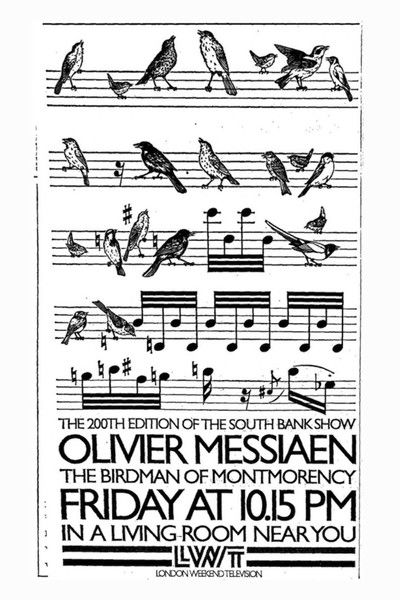
Olivier Messiaen played a leading role in the evolution of 20th-century music. In this classic interview, the late composer talks on topics such as his love of nature and his fervent Christian faith, two themes that profoundly shaped his work; his views on rhythm and tonal color; his relationship with his mother, the poet Cécile Sauvage; and his professorship at the Paris Conservatoire. Film clips of Messiaen improvising on the organ and notating birdsong for his compositions—plus excerpts of his music, some of which are performed by his wife, the celebrated pianist Yvonne Loriod—provide a deeper appreciation of his special genius. (79 minutes)

Others

Budget

$--

Revenue

$--

Status

Released

Original Language

English

Runtime

79 mins

Rating

0/10

Release Date

01 January 1984

Country

Cast

Similar Movies

8.0

Reich: Three Tales

May 2002 •English

"Three Tales" is a video music work by American composer Steve Reich and video artist Beryl Korot. It is set in three "Acts", each depicting a technological advance of the 20th century and its negative implications on humanity: the dirigible airship Hindenburg and its explosion; the Atom Bomb and its testing on Bikini Atoll; and Dolly the sheep, first successful genetic cloning of a mammal.

0.0

Line by Line - a film on the composer Ernstalbrecht Stiebler

November 2014 •German

A cello piece A punt ride Thoughts about music and composition The eight lines of Ernstalbrecht Stiebler’s cello piece Sequenz 2 alternating with his thoughts about slowness, space, reduction, repetition, resonance, liveliness and emotion A cinematic continuum

0.0

To B or to B Flat - the composer Boudewijn Buckinx

May 2019 •English

Who gets the idea to write “Nine unfinished symphonies” - one of them perhaps the shortest Symphony in music history? Or "1001 sonatas’ - each lasting about a minute but in total being one of the longest pieces ever written? Like a postmodern Erik Satie the Belgium composer Boudewijn Buckinx is using music history as a playing field. The classical music audience is irritated, the avant-gardist wrinkles his nose... "Daisies in a Meadow" - that's how Buckinx described his "1001 Sonatas” for violin and piano, They play a leading role in our film, in the supporting roles the Spanish sun and the Belgian rain. The latter, however, did not show up at the set - just as you always have to be prepared for surprises with Boudewijn Buckinx. "Why is my music so simple? - Why is my music so complex?" With a wink, Buckinx gives various answers to these recurring questions. The portrait of an immensely productive artist who is radically taking his own path.

8.8

Einstein on the Beach

January 2014 •English

This seminal work of avant-garde opera from composer Philip Glass and director Robert Wilson arrives full-circle, coming to France, the site of its 1976 Avignon Festival world premiere, at the tail end of this 2014 revival tour for a landmark Theâtre du Châtelet production and a first ever filming by award-winning arts filmmaker Don Kent. Eschewing conventional narrative, the opera revolves loosely around pacifist Einstein’s relationship to the creation of the atomic bomb.

0.0

The West is a Land of Infinite Beginnings

January 2021 •English

Alone in the woods, a young man is pursued by a horrifying specter and by visions of his deceased sisters. A meditation on the precarious uncertainty of the American Dream and the role that uncontrollable forces play in our lives, The West is a Land of Infinite Beginnings is inspired by a harrowing scene from the opera Proving Up, by composer Missy Mazzoli and librettist Royce Vavrek.

10.0

The Muppets: Classical Chicken

July 2008 •English

10.0

The Metropolitan Opera: Marnie

November 2018 •English

Composer Nico Muhly unveils his second new opera for the Met with this gripping reimagining of Winston Graham’s novel, set in the 1950s, about a beautiful, mysterious young woman who assumes multiple identities. Director Michael Mayer and his creative team have devised a fast-moving, cinematic world for this exhilarating story of denial and deceit, which also inspired a film by Alfred Hitchcock. Mezzo-soprano Isabel Leonard sings the enigmatic Marnie, and baritone Christopher Maltman is the man who pursues her—with disastrous results. Robert Spano conducts.

0.0

No Ideas But in Things - the composer Alvin Lucier

March 2012 •English

“Don’t ask me what I mean, ask me what I’ve made” – inspired by this motto, the documentary accompanies the American composer Alvin Lucier (1931 - 2021) on concert travels to The Hague (Netherlands) and Zug (Switzerland). Lucier explains and comments on his œuvre – from his early live electronics performances (MUSIC FOR SOLO PERFORMER,1965 and BIRD AND PERSON DYNING, 1975) up to the premiere of his ensemble piece PANORAMA 2 in 2011. One of Lucier’s key works, I AM SITTING IN A ROOM (1969), is introduced as a central structuring device in the film. At home in Middletown, Connecticut, Lucier offers rare insights into the beginnings of his pioneering works, his time as a member of the Sonic Arts Union, his relations with John Cage and David Tudor, as well as his teaching practice at Wesleyan University.

10.0

Tomorrow will be the same

March 2017 •Russian

Insatiable lust reigned over senseless flesh. Like august flies, trying to escape certain death, people before the apocalypse started to copulate, until every single one was completely exhausted. Only two people remained untouched. Having merged, like Salmacis and Hermaphroditus, in music that gave them eternal life, they wander timeless, empty spaces. Their destiny - to save humanity. But humanity means nothing to them. Main characters of the movie, Kirill Shirokov and Sasha Elina, are real musicians and founders of 'the same' ensemble, specialized in performing quite music related to certain space and time. During the film they perform music from ‘every day melodies’ series composed by Kirill Shirokov. The movie is the first part of mini-series discovering the territory of contemporary art music.

0.0

The Lost Paradise

September 2015 •English

He is the most performed contemporary composer in the world. And yet he rarely ventures out in public, prefers to keep quiet about his music, feels at home in the forests of Estonia and generates therewith - perhaps involuntarily - the impression of a recluse, which is attributed to him again and again: Arvo Part. In The Lost Paradise, we follow him over a period of one year in his native Estonia, to Japan and the Vatican. The documentary is framed by the stage production of Adam's Passion, a music theater piece based on the Biblical story of the fall of Adam featuring three key works by Arvo Part. The world-renowned director Robert Wilson has brought this work to the stage in a former submarine factory in Tallinn. Tracing their creative process, the film offers rare and personal insights into the worlds of two of the most fascinating personalities in the international arts and music scene.

0.0

John Adams conducts John Adams

October 2015 •English

Like many of John Adams’ operas, Doctor Atomic is based on recent world historical events—here, the effusive Robert Oppenheimer, “father of the atomic bomb,” anxiously awaits the bomb’s first test in Los Alamos, New Mexico. Adams adapted the work into a symphony, comprising its three main acts. In the second half of the program, Adams conducts his 2015 violin concerto, Scheherazade.2, which restages the tale of the One Thousand and One Nights heroine as a strong woman navigating a patriarchial society, incarnated by the solo violin part. The work was composed specifically for Canadian-American virtuoso Leila Josefowicz and co-commissioned by the Royal Concertgebouw Orchestra, who perform it to perfection. The evening then closes out with Tromba Lontana, an orchestral fanfare written to mark the 150th anniversary of Texas’s independence from Mexico in 1836.

0.0

Philip Glass: Looking Glass

January 2005 •English

This documentary captures the overflowing energy and activity of one today's greatest composers, Philip Glass, and allows us to follow him from New York to London and from Paris to Boston. He speaks about his beginnings, his moving to Paris for two years of intensive study with Nadia Boulanger, his meeting with Indian musician Ravi Shankar and director Robert Wilson, who had a deep influence on his career. The film also shows him at work on the last details of his opera The Sound of a Voice, directed by Robert Woodruff and conducted by Alan Johnson. Éric Darmon's camera, with its poetic shots and original framings, takes us for a musical journey into seven months of the life of the composer who, rising from the underground scene of the seventies, brought on a revolution in modern theater.

0.0

A Private Music Lesson with Yvonne Loriod

January 1991 •French

Yvonne Loriod was not only an incredible performer of the music of her time, but also Olivier Messiaen's muse, the one in whom and for whom he found the natural and concrete extension of his art, of his inspiration. This documentary is a beautiful testament to what this great artist represented.

0.0

Apparition of the Eternal Church

January 2006 •English

The movie captures the responses of 31 authors, musicians, filmmakers and dancers to Olivier Messiaen's monumental organ work "Apparition of the Eternal Church." Listening to the 10-minute piece through headphones, the documentary subjects-most of whom are outsiders to the church and do not know what they're hearing-put Messiaen's project to the test: Is it possible to portray, through time-bound, invisible sound, the spiritual, the architectural, the eternal? The result is a collective interpretation improvising its way through an aesthetic landscape defined by violent contradictions. Resolution abuts eternity, eroticism asceticism, spiritual ecstasy physical torture. Together, the music and its interpreters conjure something like what William Blake famously called the marriage of heaven and hell.

7.8

The Conductor

January 2022 •English

Leonard Bernstein’s protégée Marin Alsop reveals how she smashed the glass ceiling to become an internationally renowned conductor.

7.7

The Metropolitan Opera: The Exterminating Angel

November 2017 •English

After the acclaimed Met premiere of Thomas Adès's "The Tempest" in 2012, the composer returned with another masterpiece, this time inspired by filmmaker Luis Buñuel's seminal surrealist classic "El Ángel Exterminador", during the 2017–18 season. As the opera opens, a group of elegant socialites gather for a lavish dinner party, but when it is time to leave for the night, no one is able to escape. Soon, their behavior becomes increasingly erratic and savage. The large ensemble cast tackles both the vocal and dramatic demands of Adès's opera with one riveting performance after another. Tom Cairns, who also penned the work's libretto, directs an engrossing and inventive production, using a towering wooden archway to trap the characters onstage. And Adès himself takes the podium to conduct the frenzied score, which features a host of unconventional instruments, including the eerie electronic ondes Martenot.

0.0

John Cage: From Zero

December 1995 •English

A fascinating study of merging form with content, broken into four shorts, each complete with opening title and closing credits: "19 Questions," "Fourteen," "Paying Attention," and "Overpopulation and Art."

10.0

The Fire and the Rose

January 1990 •English

A documentary on the life and work of the composer Sofia Gubaidulina.

0.0

A Shape of Time - the composer Jo Kondo

March 2016 •English

Jo Kondo (*1947) is one of the most interesting composers of contemporary music in Japan. His music is composed intuitively and at the same time it is highly abstract. Without clear directionality and at the same time not without form. For a Japanese audience it sounds “Western” and in the West it is regarded “Japanese”. A music in between categories. Like Kondo’s music the film is shifting between places and directions: a concert in the Muziekgebouw in Amsterdam, an elaborate sushi bar in Tokyo, a CD-production in a Cologne radio station, the Zuisenji temple in Kondo’s neighborhood in Kamakura. Kondo wants his music to appear “normal”, without spectacular surface or narrative elements. A concept of “normality” you may also find in the films of Japanese filmmaker Yasujiro Ozu, who – like Kondo – spent most of his life in Kamakura.

0.0

Knots and Fields

January 2010 •English

Knots and Fields examines the aesthetic debates and tensions that have animated the Darmstadt courses over six decades, exploring their relevance today in an increasingly globalised environment.