Movies

HomeMoviesSearchTV SeriesBookmarksView Source
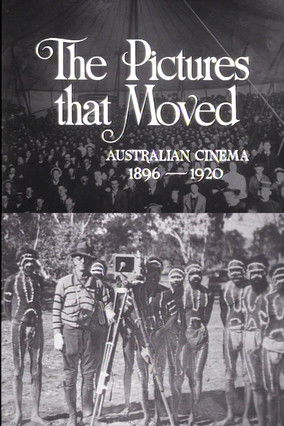
The Pictures That Moved: Australian Cinema 1896-1920

The Pictures That Moved: Australian Cinema 1896-1920

Genres

Documentary

OverView

Part 1 of the History of Australian Cinema series. Australian cinema from the very beginning, from the newsreels, ethnographic and actuality films, to the controversy of "The Story of the Kelly Gang" and the success of "The Sentimental Bloke".

Others

Budget

$--

Revenue

$--

Status

Released

Original Language

English

Runtime

45 mins

Rating

0/10

Release Date

01 January 1968

Country

Australia

Cast

Reg Perry

Reg Perry

Himself

Herc McIntyre

Herc McIntyre

Himself

Similar Movies

7.1

The Arrival of a Train at La Ciotat

June 1896 •French

A group of people are standing along the platform of a railway station in La Ciotat, waiting for a train. One is seen coming, at some distance, and eventually stops at the platform. Doors of the railway-cars open and attendants help passengers off and on. Popular legend has it that, when this film was shown, the first-night audience fled the café in terror, fearing being run over by the "approaching" train. This legend has since been identified as promotional embellishment, though there is evidence to suggest that people were astounded at the capabilities of the Lumières' cinématographe.

7.5

Berlin: Symphony of a Great City

September 1927 •German

A day in the city of Berlin, which experienced an industrial boom in the 1920s, and still provides an insight into the living and working conditions at that time. Germany had just recovered a little from the worst consequences of the First World War, the great economic crisis was still a few years away and Hitler was not yet an issue at the time.

7.0

Los 5 Faust de F. W. Murnau

November 2002 •Spanish

7.1

Nanook of the North

June 1922 •English

This pioneering documentary film depicts the lives of the indigenous Inuit people of Canada's northern Quebec region. Although the production contains some fictional elements, it vividly shows how its resourceful subjects survive in such a harsh climate, revealing how they construct their igloo homes and find food by hunting and fishing. The film also captures the beautiful, if unforgiving, frozen landscape of the Great White North, far removed from conventional civilization.

5.7

Something in the Water

February 2008 •English

Something in the Water explores the rock phenomenon that is music in WA. How can the most isolated city in the world have exploded with so many successful bands over the years? Across decades and genres, Something in the Water asks "what is responsible for the sparkling talent pool?"

6.7

Workers Leaving the Lumière Factory

March 1895 •French

Working men and women leave through the main gate of the Lumière factory in Lyon, France. Filmed on 22 March 1895, it is often referred to as the first real motion picture ever made, although Louis Le Prince's 1888 Roundhay Garden Scene pre-dated it by seven years. Three separate versions of this film exist, which differ from one another in numerous ways. The first version features a carriage drawn by one horse, while in the second version the carriage is drawn by two horses, and there is no carriage at all in the third version. The clothing style is also different between the three versions, demonstrating the different seasons in which each was filmed. This film was made in the 35 mm format with an aspect ratio of 1.33:1, and at a speed of 16 frames per second. At that rate, the 17 meters of film length provided a duration of 46 seconds, holding a total of 800 frames.

0.0

Lair Of The Killer Crocs

May 2015 •English

Paul "Gator Boy" Bedard and croc hunter "Crocodile Mick Pittman" journey through the Northern Territory to explore the invasion of crocodiles.

10.0

1932: The Great Emu War

July 2020 •English

This short film involves a dramatic retelling of Australia's actual war against their own national bird, two soldiers fight for their lives to escape a horde of bloodthirsty emus after a surprise attack. Link for movie : https://www.youtube.com/watch?v=dkmflJne_yU

0.0

Censored!

December 1999 •English

A documentary about the cultural effect of film censorship, focusing on the tumultuous times of the teens and early 1920s in America.

0.0

In My Own Words

June 2017 •English

The raw, heartfelt and often funny journey of adult Aboriginal students and their teachers as they discover the transformative power of reading and writing for the first time.

0.0

I'm Not Gay

June 2023 •English

A conflicted gay man struggles to teach his younger self about the challenges of adult life. Searching for answers inside stories from his past, he must confront his nature and the man he will become. Documentary meets musical feature in this experimental coming of age drama about power and masculinity in modern day Australia.

10.0

Australia Says Yes

November 2018 •English

Packed with drama, high emotions and cliff-hanger moments, Australia Says Yes is the intimate and personal history of struggle and perseverance that propelled Australia to say Yes to marriage equality. The film shows how a group of determined individuals fought tirelessly against unjust laws that treated LGBTIQ people as second-class citizens, creating a movement that saw them go from criminals to legally equal over the course of five decades.

0.0

Jisoe

January 2005 •English

A year in the life of troubled Australian graffiti artist Justin Hughes.

0.0

My Life As I Live It

December 1993 •English

In her second film, MY LIFE AS I LIVE IT (1993), Essie Coffey returns to her home in Dodge City where she and the A-Team are running in the shire elections. Inter-cutting between 1993 and 1978, the film presents the fascinating contrasts of a society in transition. Some of the kids we met in the earlier film now have families of their own and are involved in education, art and sports. Others are drifting, trying to cope with alcohol and depression. Most significantly, community programs offer the possibility of dignity and self-determination. In this film, Essie shows us the Community Development Employment Program (CDEP) making a real difference. Although the CDEP has now come under attack from the Federal government, MY LIFE AS I LIVE IT portrays the CDEP as providing meaningful work and services to an impoverished remote community.

5.2

Carmencita

March 1894 •

The first woman to appear in front of an Edison motion picture camera and possibly the first woman to appear in a motion picture within the United States. In the film, Carmencita is recorded going through a routine she had been performing at Koster & Bial's in New York since February 1890.

8.0

Among Wild Birds

November 1927 •

Finland’s first nature documentary. The filmmakers’ expedition leads them all the way to the Åland Islands and the Karelian Isthmus.

6.8

Burning

September 2021 •English

Follows the deadly Australian bushfires of 2019-2020, known as ‘Black Summer’. Burning is an exploration of what happened as told from the perspective of victims of the fires, activists and scientists.

6.0

Traffic Crossing Leeds Bridge

October 1888 •

A film by Louis Aimé Augustin Le Prince, shot in late October 1888, showing pedestrians and carriages crossing Leeds Bridge.

7.0

Wombats: Bulldozers Of The Bush

January 1992 •English

When shipwrecked sailors first encountered wombats, they did what they had to do to survive - they ate them! More than 200 hundred years later, the wombat still suffers at our hands, blamed for damaging fences and fouling pastures, this film examines the myths and realities of wombat life, above and below the ground, as scientists begin to understand these intrepid and resourceful Bulldozers of the Bush.

10.0

Takayna

Invalid date •English

takayna / Tarkine in northwestern Tasmania is home to one of the last undisturbed tracts of Gondwanan rainforest in the world, and one of the highest concentrations of Aboriginal archaeology in the hemisphere. Yet this place, which remains largely as it was when dinosaurs roamed the planet, is currently at the mercy of destructive extraction industries, including logging and mining. Weaving together the conflicting narratives of activists, locals and Aboriginal communities, and told through the experiences of a trail running doctor and a relentless environmentalist, this documentary, presented by Patagonia Films, unpacks the complexities of modern conservation and challenges us to consider the importance of our last truly wild places.