Movies

HomeMoviesSearchTV SeriesBookmarksView Source
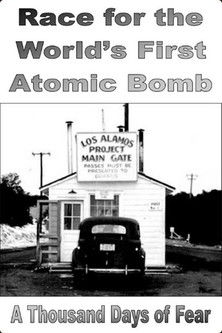
Race for the World's First Atomic Bomb: A Thousand Days of Fear

Race for the World's First Atomic Bomb: A Thousand Days of Fear

Genres

DocumentaryHistory

OverView

The personalities behind the creation of the world's first atomic bomb were as extraordinary, and often as explosive, as the science they were working in. This is the inside-the-barbed-wire story of the men and women who worked on the Manhattan Project at Los Alamos. Through first-hand accounts and never-before-seen interviews, this documentary looks inside the atomic insiders' hearts and minds, their triumphs and failures, their bravery in the face of paralyzing fear and, ultimately, their war-winning and world-changing accomplishments.

Others

Budget

$--

Revenue

$--

Status

Released

Original Language

English

Runtime

60 mins

Rating

0/10

Release Date

10 August 2015

Country

United Kingdom

Cast

Karen Ellenburr

Karen Ellenburr

Narrator

Similar Movies

8.6

The Dawn of Kaiju Eiga

April 2019 •Spanish

Japan, 1954. A legend emerges from the ashes of Hiroshima and Nagasaki, devastated by atomic bombs in 1945. The creature's name is Godzilla. The film that tells its story is the first of kaiju eiga, the giant monster movies.

7.2

Trinity and Beyond: The Atomic Bomb Movie

September 1995 •English

"Trinity and Beyond" is an unsettling yet visually fascinating documentary presenting the history of nuclear weapons development and testing between 1945-1963. Narrated by William Shatner and featuring an original score performed by the Moscow Symphony Orchestra, this award-winning documentary reveals previously unreleased and classified government footage from several countries.

0.0

Vive La France

August 2014 •English

Kua and Teriki will soon get married. They live on the distant Tureia island in the French Polynesia, Pacific Ocean and have just been told that something is wrong with their son Maokis heart. It is a consequence of living only 100 km away from the island of Moruroa, where France has tested 193 atom bombs for 30 years. Several of their family members are sick and Moruroa can soon collapse, which can lead to a tsunami likely to drown all of them. Vive La France is a personal and intimate story about harvesting the consequences of the French atomic program.

7.3

The Half-Life of Genius Physicist Raemer Schreiber

July 2018 •English

Our two-hour film highlights the life and career of Dr. Schreiber with respect and clarity. Raemer, his wife Marge, and young daughter Paula would move to the high-desert of New Mexico where he and other brilliant minds would change the world forever.

7.0

Thirteen Days

December 2000 •English

The story of the Cuban Missile Crisis in 1962—the nuclear standoff with the USSR sparked by the discovery by the Americans of missile bases established on the Soviet-allied island of Cuba.

7.5

Tokyo Phoenix

May 2017 •French

In 150 years, twice marked by total destruction —a terrible earthquake in 1923 and incendiary bombings in 1945— followed by a spectacular rebirth, Tokyo, the old city of Edo, has become the largest and most futuristic capital in the world in a transformation process fueled by the exceptional resilience of its inhabitants, and nourished by a unique phenomenon of cultural hybridization.

0.0

Uncle Jack: Manhattan Project and Beyond

November 2016 •English

The Manhattan Project was an enormous undertaking that required the efforts of many of the world's most brilliant intellectuals. Hundreds of physicists, mathematicians, and engineers were needed to design, build, and test the world's first atomic weapon and the Unites States government did everything in its power to lure these individuals to the Manhattan Project. Documentary to include: Interviews with Scientists conducted by the World War II Foundation Interviews with World War II Historians Interviews with WWII veterans Interviews with those who worked with John Gray in the world of Atomic Energy Interviews with authors who have written extensively about the Manhattan Project Interviews with people from the world of academia. This film is personal: One of those assigned to the project was my uncle John Edmund Gray, a University of Rhode Island graduate with a brilliant mind. —Tim Gray

7.4

Hiroshima

October 1953 •Japanese

Historical fiction about the aftermath of the atomic bombing of Hiroshima, Japan, on 6 August 1945, and its effects on various civilians, especially children, of that city.

7.7

Hiroshima Mon Amour

June 1959 •French

The deep conversation between a Japanese architect and a French actress forms the basis of this celebrated French film, considered one of the vanguard productions of the French New Wave. Set in Hiroshima after the end of World War II, the couple -- lovers turned friends -- recount, over many hours, previous romances and life experiences. The two intertwine their stories about the past with pondering the devastation wrought by the atomic bomb dropped on the city.

7.5

Empire of the Sun

December 1987 •English

Jamie Graham, a privileged English boy, is living in Shanghai when the Japanese invade and force all foreigners into prison camps. Jamie is captured with an American sailor, who looks out for him while they are in the camp together. Even though he is separated from his parents and in a hostile environment, Jamie maintains his dignity and youthful spirit, providing a beacon of hope for the others held captive with him.

0.0

Nuclear Armageddon: How Close Are We?

January 2024 •English

With the Doomsday Clock the closest it's ever been to midnight, Jane Corbin investigates the proliferation of nuclear weapons across the globe. She visits Los Alamos, home to the United States’ nuclear weapons development facility and the historic home of Oppenheimer’s Manhattan Project. In Scotland, she reveals the strategy behind Britain’s nuclear deterrent, and speaks to campaigners in Suffolk fighting against US weapons they fear will be based on UK soil. Jane also discovers how many of the global agreements and safeguards that have constrained the spread of nuclear weapons since the 1970s are breaking down. This is a story told by the scientists, investigators and diplomats who set the clock and have fought to ensure that the ultimate deterrent has not been used in over 70 years.

7.2

Hiroshima

August 2005 •English

The documentary recounts the world's first nuclear attack and examines the alarming repercussions. Covering a three-week period from the Trinity test to the atomic bombing of Hiroshima, the program chronicles America's political gamble and the planning for the momentous event. Archival film, dramatizations, and special effects feature what occurred aboard the Enola Gay (the aircraft that dropped the bomb) and inside the exploding bomb.

7.3

The Atomic Cafe

March 1982 •English

A disturbing collection of 1940s and 1950s United States government-issued propaganda films designed to reassure Americans that the atomic bomb was not a threat to their safety.

6.2

Fat Man and Little Boy

October 1989 •English

Assigned to oversee the development of the atomic bomb, Gen. Leslie Groves is a stern military man determined to have the project go according to plan. He selects J. Robert Oppenheimer as the key scientist on the top-secret operation, but the two men clash fiercely on a number of issues. Despite their frequent conflicts, Groves and Oppenheimer ultimately push ahead with two bomb designs — the bigger "Fat Man" and the more streamlined "Little Boy."

9.0

Lise Meitner: The Mother of the Atom Bomb

February 2013 •German

To historians, physicist Lise Meitner deserves to be placed on a par with Einstein, Heisenberg and Otto Hahn. In the 1930s on the verge of World War II, she led a small group of scientists who discovered that splitting the atomic nucleus of uranium releases enormous energy. This extraordinary film tells the story of a woman who was far ahead of her time as a scientist and a pioneer of feminism.

7.7

Twice: The Extraordinary Life of Tsutomu Yamaguchi

January 2010 •Japanese

Tsutomu Yamaguchi is a hibakusha. A survivor of both atomic bomb blasts in 1945. First at Hiroshima, then again at Nagasaki. Now nearing 90, Yamaguchi finally speaks out. Breaking taboos of shame and sorrow, he responds to a call to fight for a world without nuclear weapons by telling his story, so that no one else will ever have to tell one like it again. Twice reconstructs Yamaguchi’s experiences in 1945 Japan, interviews him on the after-effects of exposure and documents the last five years of the late-blooming activist’s life.

3.8

Nuclear Rescue 911: Broken Arrows & Incidents

January 2001 •English

Since 1950, there have been 32 nuclear weapon accidents, known as "Broken Arrows." A Broken Arrow is defined as an unexpected event involving nuclear weapons that result in the accidental launching, firing, detonating, theft or loss of the weapon. To date, six nuclear weapons have been lost and never recovered.Now, recently declassified documents reveal the history and secrecy surrounding the events known as "Broken Arrows". There have been 32 nuclear weapon accidents since 1950. Six of these nuclear weapons have been lost and never recovered. What does this say about our defense system? What does this mean to our threatened environment? What do we do to rectify these monumental "mistakes"? Using spectacular special effects, newly uncovered and recently declassified footage, filmmaker Peter Kuran explores the accidents, incidents and exercises in the secret world of nuclear weapons.

6.0

You Can Beat the A-Bomb

December 1950 •English

An educational film that instructs people on how to survive atomic bombs and the radiation they emit while following a family facing nuclear attack who calmly prepare for the aftermath. Shows the various modes of Civil Defense that were being developed to protect the American population in the event of a nuclear war.

8.0

Reich: Three Tales

May 2002 •English

"Three Tales" is a video music work by American composer Steve Reich and video artist Beryl Korot. It is set in three "Acts", each depicting a technological advance of the 20th century and its negative implications on humanity: the dirigible airship Hindenburg and its explosion; the Atom Bomb and its testing on Bikini Atoll; and Dolly the sheep, first successful genetic cloning of a mammal.

6.6

Red Joan

September 2018 •English

London, England, May 2000. The peaceful life of elderly Joan Stanley is suddenly disrupted when she is arrested by the British Intelligence Service and accused of providing information to communist Russia during the forties.