Movies

HomeMoviesSearchTV SeriesBookmarksView Source
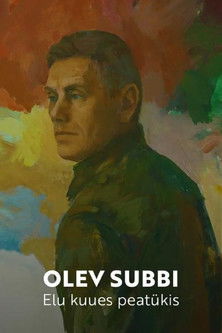
Olev Subbi. Elu kuues peatükis

Olev Subbi. Elu kuues peatükis

Genres

Documentary

OverView

Olev Subbi (1930–2013) was one of the most significant painters of the second half of the 20th century. His art constantly strived for harmony and beauty, reviving lost memories. This documentary reconstructs the environments of his paintings, features interviews with artists and Subbi’s contemporaries, and incorporates archival footage, creating a multilayered perspective on the life and work of this remarkable artist.

Others

Budget

$--

Revenue

$--

Status

Released

Original Language

Estonian

Runtime

52 mins

Rating

0/10

Release Date

18 March 2021

Country

Estonia

Cast

Similar Movies

8.0

James Ensor: Demons Teasing Me

October 2010 •English

This film explains what James Ensor (1860-1949) meant for the development of art and makes palpable where he got his inspiration from.

5.0

Max Ernst: Journey into the Subconscious

January 1964 •English

The inner world of the great painter Max Ernst is the subject of this film. One of the principal founders of Surrealism, Max Ernst explores the nature of materials and the emotional significance of shapes to combine with his collages and netherworld canvases. The director and Ernst together use the film creatively as a medium to explain the artist's own development.

2.0

El universo en una caja

October 2022 •Spanish

An account of the life and work of the multidisciplinary Spanish artist Mariano Fortuny Madrazo (1871-1949), textile and fashion designer, set designer, photographer, painter and engraver, known as the Leonardo Da Vinci of the 20th century.

8.0

Hinter dem Vorhang: Das Geheimnis Vermeer

June 2021 •German

0.0

The Lost Portrait of Bonnie Prince Charlie: A Culture Show Special

February 2014 •English

In 2009, art detective Dr Bendor Grosvenor caused a national scandal by proving that the Scottish National Portrait Gallery's iconic portrait of Bonnie Prince Charlie, the rebel Stuart who almost seized power in 1745, was not in fact him. Keen to make amends, and suspecting that a long-lost portrait of the prince by one of Scotland's greatest artists, Allan Ramsay, might still survive, Bendor decides to retrace Charles's journey in the hope of unravelling one of the greatest mysteries in British art.

7.5

The Painting

November 2019 •Spanish

For three and a half centuries, from the same day that Diego Velázquez (1599-1660) applied his last brushstroke to the canvas, the enigma of “Las meninas, o La familia de Felipe IV” (1656) has not been deciphered. The secret story of a painting unveiled as if it was the resolution of a perfect crime.

0.0

Equipo Crónica. Arte de trinchera

February 2025 •Spanish

5.3

The Treasures of Saxony: How August III Built His Collection

November 2021 •German

Year 1763, the Seven Years' War is about to end. August III, Elector of Saxony and King of Poland, has died, leaving empty the royal treasury and an extraordinary collection of paintings, sculptures, jewelry and goldsmith masterpieces, which he considered a symbol of his greatness, and that of Dresden, one of the European capitals of Baroque art.

7.2

The Cinematograph: Birth of an Art

October 2021 •French

Throughout the 19th century, imaginative and visionary artists and inventors brought about the advent of a new look, absolutely modern and truly cinematographic, long before the revolutionary invention of the Lumière brothers and the arrival of December 28, 1895, the historic day on which the first cinema performance took place.

0.0

Der Schatz von Timbuktu, die Geschichte einer Rettung

February 2017 •German

4.5

Egon Schiele: Between Love and Hate

November 2018 •German

An account of the short life and the astonishing and provocative work of the Austrian painter Egon Schiele (1890-1918), seen through the peculiar point of view and the critic voices of the women who defined the paramount milestones of his existence: Gerti, his sister; Wally, his main model and lover; and Edith, his wife. A brief story of love, hate, betrayal and misfortune.

0.0

Matisse: A Sort of Paradise

Invalid date •English

A survey of the painting of Henri Matisse, revealing the development of the idyllic quality in his work. Studies pictures from the beginning of his career, and follows the spontaneous flowering of color.

7.0

The Genius of Turner: Painting the Industrial Revolution

April 2013 •English

A film that looks at the genius of JMW Turner in a new light. There is more to Turner than his sublime landscapes - he also painted machines, science, technology and industry. Turner's life spans the Industrial Revolution, he witnessed it as it unfolded and he painted it. In the process he created a whole new kind of art. The programme examines nine key Turner paintings and shows how we should re-think them in the light of the scientific and Industrial Revolution. Includes interviews with historian Simon Schama and artist Tracey Emin.

6.8

Dark Star: H. R. Giger's World

October 2014 •German

An account of the life and work of Swiss painter, sculptor, architect and designer H. R. Giger (1940-2014), tormented father of creatures as fearsome as they are fascinating, inhabitants of nightmarish biomechanical worlds.

8.0

Phantasia

March 2024 •

X-ray images were invented in 1895, the same year in which the Lumière brothers presented their respective invention in what today is considered to be the first cinema screening. Thus, both cinema and radiography fall within the scopic regime inaugurated by modernity. The use of X-rays on two sculptures from the Bilbao Fine Arts Museum generates images that reveal certain elements of them that would otherwise be invisible to our eyes. These images, despite being generally created for technical or scientific purposes, seem to produce a certain form of 'photogénie': they lend the radiographed objects a new appearance that lies somewhere between the material and the ethereal, endowing them with a vaporous and spectral quality. It is not by chance that physics and phantasmagoria share the term 'spectrum' in their vocabulary.

6.0

The Mystery of Mona Lisa

July 2014 •Spanish

The Mona Lisa, also known as La Gioconda, is a work by Leonardo Da Vinci and one of the most famous paintings in the world. It is currently on display at the Louvre Museum in Paris and is visited by millions of people every year. The Gioconda has not only gone down in art history for its artistic value, but also for the mystery surrounding its creation. Painted between 1503 and 1519, Da Vinci's last great work was revolutionary for the painting techniques used. After several analyses of the painting, it is known that the artist first made the drawing and then applied the oil paint. Da Vinci was the inventor of the 'sfumato' or blurring technique, which consists of blurring the outline of the drawing and softening the colors to create a play of shadows that gives the figure a three-dimensional effect.

0.0

The Mountain That Had To Be Painted

May 2011 •English

Documentary about the painters Augustus John and James Dickson Innes who, in 1911, left London for the wild Arenig Valley in North Wales. Over three years, they created a body of work to rival the visionary landscapes of Matisse.

7.0

Versailles Rediscovered: The Sun King's Vanished Palace

March 2019 •French

Based on the latest technological and scientific advances, this documentary explores the palace's architectural past to resurrect Louis XIV's vanished Versailles. Versailles was an ongoing building site at the time of Louis XIV and continued to be transformed by its successive occupants later on. The Versailles we know today only vaguely resembles the Versailles of the Sun King. Most of its original features and apartments no longer exist. Thanks to the digitisation of thousands of plans, a team of scientists takes us back in time to explore this forgotten past in a new way, through a large-scale reconstruction project to bring back the Versailles of Louis XIV as he designed it, according to his requirements and dreams.

0.0

Ugly Beauty

January 2010 •English

Documentary in which art critic Waldemar Januszczak argues that beauty is still to be found in modern art, despite several recent books claiming the contrary.

0.0

Die Brücke: The Birth of Modern Art in Germany

January 1972 •German

This movement marks the beginning of modern art in Germany. It is the German equivalent of French Fauvism, from which it draws its main inspiration, but it carries an Expressionist and social emphasis that is characteristic of Nordic 'angst.' The artists of Die Brucke were restless creatures, over-sensitive, haunted by religious, sexual, political or moral obsessions. Dramatic landscapes and nudes, mystical and visionary compositions, scenes of the countryside, the streets, the circus, the cafe-dansants and the demi-monde were their principal subjects. Their pure colours blaze in acid stridency, encompassed by rough, dry contours which show the influence of African art and primitive woodcuts. The work of the following is shown: Kirchner, Fritz Bleyl, Erich Heckel, Schmidt-Rottluff, Otto Muller, Emil Nolde and Max Pechstein.